How Is Fiberglass Grating Manufactured? Molded vs. Pultruded Processes Explained
Fiberglass grating is manufactured by combining glass-fiber reinforcement with a thermosetting resin, then forming and curing the composite into an open mesh or structural profile. Molded fiberglass grating places wet reinforcement into a mold before compression and heat curing, while pultruded fiberglass grating pulls continuous glass strands through resin and a heated die. I use this distinction as the starting point because manufacturing direction affects stiffness, load paths, span capability, surface texture, and installation requirements.
Key Takeaways
Molded grating distributes reinforcement in multiple directions and provides balanced panel performance.
Pultruded grating aligns continuous fibers longitudinally for higher directional stiffness and longer potential spans.
Resin selection influences corrosion resistance, fire behavior, ultraviolet exposure, and service temperature.
Manufacturing inspection must identify voids, incomplete wet-out, resin imbalance, dimensional variation, and damaged cross-rods.
Product-specific load tables matter more than choosing molded or pultruded construction by name alone.
What Is Fiberglass Grating?
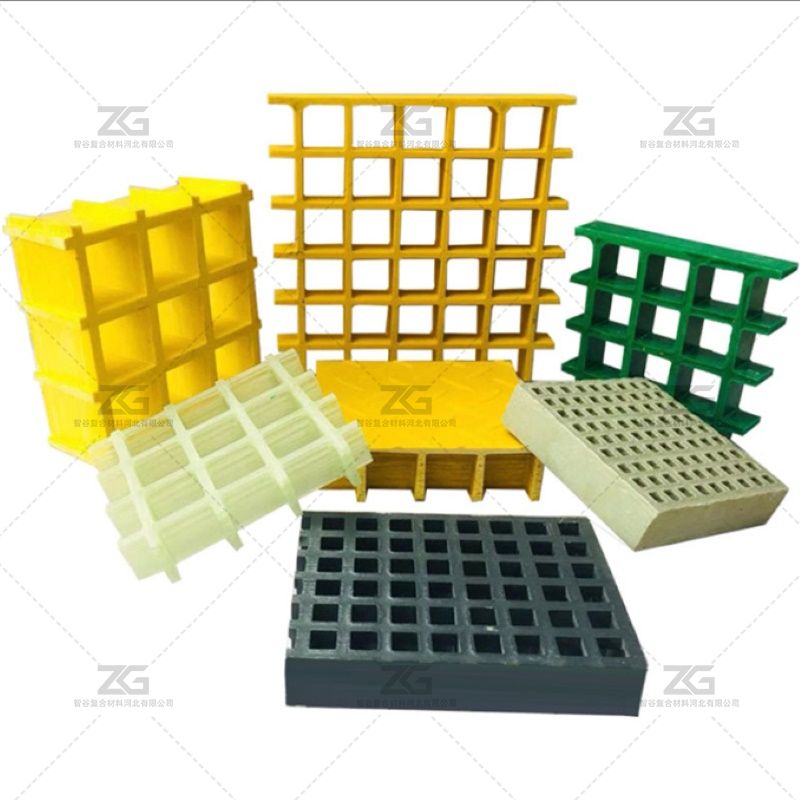
Fiberglass grating, also called FRP grating, is a structural panel made from glass fibers embedded in polyester, vinyl ester, or another thermosetting resin system. The finished panel normally contains load-bearing bars, transverse bars, and an open mesh that allows drainage, ventilation, and light transmission. Common forms include square mesh, rectangular mesh, covered grating, concave nonslip grating, and panels with abrasive quartz surfaces.
Manufacturers use fiberglass grating for industrial platforms, wastewater treatment plants, chemical processing areas, marine walkways, utility facilities, cooling towers, and access flooring. The material does not rust like carbon steel, provides electrical insulation, and can reduce manual handling weight during installation. These advantages must still be evaluated against span, impact, fire, ultraviolet, temperature, and support conditions.
Zhigu identifies itself as a fiberglass products manufacturer that combines design, research and development, production, installation, sales, and international trade. Its listed product range includes FRP grating, anti-slip grating, pultruded profiles, and other fiberglass-reinforced products for industrial, municipal, energy, environmental, and construction applications. When reviewing any supplier, I recommend confirming its resin system, reinforcement architecture, testing records, dimensional controls, and traceability rather than relying only on a product name.
How Is Fiberglass Grating Manufactured? The Two Main Processes
Both processes begin with glass reinforcement, resin, pigments, additives, and tooling. Molded grating forms a complete panel in a mold, while pultruded grating first creates individual load bars and then joins them with cross-rods. The table below summarizes the main construction differences before examining each manufacturing sequence in detail.
| Factor | Molded fiberglass grating | Pultruded fiberglass grating |
|---|---|---|
| Basic construction | Continuous glass roving and mat are placed through a mold and cured as one panel | Continuous glass roving is pulled through resin and a heated die to form structural bars |
| Load direction | More balanced in multiple directions | Strongest and stiffest along the pultruded bar direction |
| Typical span behavior | Suitable for many platforms, walkways, trenches, and access panels | Often selected where directional stiffness and longer support spacing are required |
| Main advantages | Integrated panel construction, strong cross-direction behavior, molded nonslip surface | High longitudinal fiber content, consistent profiles, efficient directional strength |
| Common applications | Chemical plants, water treatment, platforms, stairs, trench covers | Industrial floors, equipment platforms, bridges, stair treads, structural framing |
The table provides a general comparison, not a design calculation. A panel’s actual performance depends on thickness, mesh size, bar dimensions, resin, fiber volume, support spacing, bearing direction, connection method, load type, and allowable deflection. I would therefore compare certified load tables for the exact product rather than treating one manufacturing method as universally stronger.
Molded Fiberglass Grating Manufacturing Process
How Is Molded Fiberglass Grating Manufactured?
Molded fiberglass grating begins with preparation of the mold, reinforcement, resin, pigment, release agent, and surface treatment. The mold determines the panel dimensions, mesh opening, bar geometry, surface profile, and edge details. Before production, operators normally check mold cleanliness, release-agent coverage, reinforcement quantity, resin batch identity, and the required panel thickness.
The reinforcement is arranged in layers across the mold. Continuous glass roving supplies the principal structural reinforcement, while chopped strand mat or other glass layers can improve transverse behavior, surface coverage, and resin distribution. Because the fibers are distributed across the panel rather than concentrated only in one direction, molded grating generally provides more balanced performance when loads or foot traffic do not follow a single axis.
Resin is then mixed with the required catalyst, accelerator, pigment, and additives under controlled ratios. Polyester resin is common for general industrial service, while vinyl ester is often specified where chemical exposure, hydrolysis resistance, or more demanding corrosion conditions require a different resin system. The manufacturer should document resin batch numbers, mix ratios, working time, ambient conditions, and curing conditions because incorrect mixing can create soft areas, incomplete curing, or resin-rich regions.
During molding, the resin must wet the glass reinforcement completely. Operators or automated equipment may use rollers, brushes, pressure, or controlled resin distribution to remove trapped air and maintain the intended fiber-to-resin ratio. Common defects at this stage include incomplete wet-out, voids, dry glass, resin-starved zones, resin-rich surfaces, fiber displacement, and contamination between layers.
The filled mold is compressed or otherwise closed, then cured through ambient, heated, or staged thermal conditions. Curing converts the liquid resin into a rigid thermoset matrix that binds the glass fibers and establishes the panel’s final geometry. The manufacturer controls cure time and temperature because under-cured panels may show low hardness or poor chemical resistance, while excessive or uneven heat can produce distortion, warping, or internal stress.
After curing, the panel is removed from the mold and inspected for flatness, mesh dimensions, bar height, surface condition, color consistency, and edge integrity. The panel may then receive a concave nonslip finish, molded grit, quartz sand treatment, or a top surface selected for wet, oily, or icy service. Cut edges are commonly sealed with compatible resin to reduce exposed fibers and limit moisture or chemical ingress.
Pultruded Fiberglass Grating Manufacturing Process
How Is Pultruded Fiberglass Grating Manufactured?
Pultruded fiberglass grating starts with continuous glass strands stored on creels or reinforcement racks. The strands are guided into the production line according to the required fiber architecture, with longitudinal roving carrying much of the primary load and additional mat or veil controlling surface finish and transverse behavior. Fiber alignment is a central difference from molded construction because the pultruded bar is designed around a principal strength direction.
The prepared fibers pass through a resin bath or injection chamber. Resin impregnation must reach the interior of the bundle, not merely coat the outside surface. Incomplete wet-out can create dry glass, internal voids, weak interfaces, and premature failure, so manufacturers monitor resin temperature, viscosity, line speed, bath condition, and the ratio of reinforcement to resin.
The impregnated reinforcement enters a heated steel die that defines the bar shape and consolidates the material. Heat initiates the curing reaction while the pulling equipment maintains a controlled line speed and continuous tension. The die temperature, pulling force, resin chemistry, and profile dimensions must remain stable enough to prevent surface cracking, distortion, incomplete cure, excessive resin accumulation, or fiber misalignment.
After leaving the die, the cured profiles are cut to specified lengths. Cross-rods are then installed through drilled holes or formed intersections, depending on the grating design. Cross-rod assembly must produce reliable mechanical engagement or bonding because damaged rods, oversized holes, poor adhesive coverage, and inconsistent spacing can reduce panel stability even when the primary pultruded bars meet their individual material requirements.
Finished panels are trimmed, drilled, sanded, coated, or sealed according to the order. Abrasive surfaces may be added when slip resistance is required, while cut edges and drilled areas should receive compatible sealing treatment. Quality checks typically include bar dimensions, mesh spacing, panel squareness, cross-rod position, connection security, surface finish, hardness, and visible defects.
Pultruded fiberglass grating is often selected for directional stiffness and higher longitudinal fiber content. However, it is not automatically suitable for every long-span application because transverse capacity, connection behavior, vibration, impact, and deflection may control the design. A longer span is possible only when the complete panel system, support layout, and allowable deflection meet the project requirements.
What Is the Difference Between Molded and Pultruded Fiberglass Grating?
The main difference between molded and pultruded fiberglass grating is the way the glass fibers are organized and bonded. Molded panels are formed and cured as integrated panels with reinforcement distributed through the mold, while pultruded panels use continuous fibers aligned mainly along individual structural bars. This creates different stiffness patterns rather than a simple ranking of one process over the other.
Molded grating usually provides better balance between the primary and transverse directions and can offer strong resistance to localized foot traffic, dropped objects, and multidirectional loading. Its integrated construction also supports molded concave surfaces and a wide range of mesh patterns. Pultruded grating generally provides greater stiffness in the fiber direction and may reduce deflection where the bars span directly between supports.
Corrosion performance depends primarily on resin chemistry, glass quality, surface protection, exposure, temperature, and manufacturing control. Both constructions can perform in chemical or wastewater environments when the resin system is correctly matched to acids, alkalis, solvents, salts, and process liquids. I would not specify a product solely because it is molded or pultruded; I would request chemical compatibility data for the actual concentration and operating temperature.
Which Is Stronger, Molded or Pultruded Grating?
Neither construction is universally stronger. Pultruded grating can provide higher stiffness and load capacity along its primary bar direction, while molded grating can provide more balanced behavior and better performance when loads act across multiple directions. Product thickness, bar geometry, fiber volume, resin system, support spacing, and allowable deflection can change the result substantially.
Material properties, panel-system performance, and installed-system performance are separate issues. A material coupon may show tensile or flexural values under laboratory conditions, but the installed floor also depends on bearing length, support spacing, clips, cutouts, joints, load paths, impact, and deflection limits. For this reason, I would treat certified span and load tables as more useful than a generic claim that one grating type is stronger.
Manufacturing Quality Control and Common Defects
A complete fiberglass grating manufacturing quality-control process follows the product from incoming materials through packaging. Important checkpoints include glass-fiber identification, resin batch verification, reinforcement placement, mixing ratio, wet-out, cure temperature, panel dimensions, surface condition, cross-rod bonding, edge sealing, and final load or deflection verification. Traceability should connect the finished panel to production date, material batches, tooling, inspection records, and corrective actions.
| Manufacturing stage | Typical control point | Defect if uncontrolled |
|---|---|---|
| Raw-material preparation | Resin identity, glass type, additive ratio | Incorrect corrosion or mechanical performance |
| Fiber placement | Orientation, layer count, reinforcement quantity | Misalignment, weak zones, uneven stiffness |
| Resin impregnation | Wet-out, viscosity, air removal | Voids, dry glass, resin-starved areas |
| Forming and curing | Temperature, pressure, line speed, cure time | Warping, soft areas, cracks, incomplete cure |
| Assembly and finishing | Cross-rods, holes, surface grit, cut-edge sealing | Poor bonding, damaged rods, slip or moisture issues |
| Final inspection | Dimensions, flatness, load data, traceability | Installation mismatch or uncertain performance |
Common visible defects include pinholes, blisters, chipped edges, surface cracks, uneven grit, inconsistent color, and dimensional variation. Internal problems may include voids, poor bonding, incomplete wet-out, resin-rich pockets, and fiber starvation that cannot be confirmed through visual inspection alone. For critical platforms, buyers should request inspection procedures, test reports, sample approvals, and written acceptance tolerances.
Typical Applications and Selection Criteria
Molded fiberglass grating is commonly used in water and wastewater facilities, chemical processing plants, marine areas, cooling towers, stairways, trench covers, and platforms with multidirectional pedestrian traffic. Its open mesh supports drainage and ventilation, while molded or abrasive surfaces help address slip risks. It is often a practical choice when balanced panel behavior and integrated nonslip geometry are important.
Pultruded fiberglass grating is commonly used for industrial platforms, longer walkway sections, stair treads, equipment access areas, bridge-like crossings, and structures where the load bars can be aligned with the primary span. Its directional stiffness can help control deflection, but the designer must confirm transverse strength and cross-rod performance. Pultruded profiles can also integrate with larger FRP structural systems.
To choose between the two, I begin with the project inputs rather than the product label. I identify the design load, point-load size, support spacing, expected impact, span direction, deflection limit, chemical exposure, temperature, fire requirement, slip condition, mesh opening, access needs, cutouts, and connection system. I then compare product-specific data and record the final resin, thickness, mesh, surface, support spacing, clip type, edge treatment, and inspection requirements in the specification.


评论
发表评论