FRP H-Beam vs Steel H-Beam: What Should Buyers Specify for Corrosive Structures?
For structural applications exposed to moisture, chemicals or other corrosive conditions, buyers should consider FRP H-beams when corrosion resistance, electrical insulation and low structural weight are important, while steel remains a practical choice where high stiffness, familiar connection methods and conventional structural design are the primary requirements. The correct material depends on span, load, deflection limits, temperature, chemical exposure and connection design rather than on material price alone.
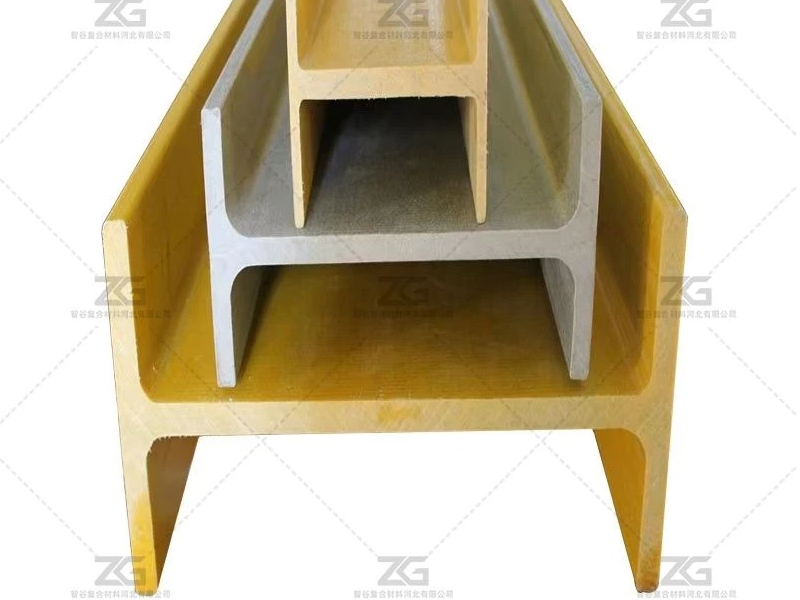
Zhigu manufactures FRP H-beams using E-glass fiber reinforced with vinyl ester or polyester resin through the pultrusion process. The company positions these structural profiles as alternatives to traditional steel in corrosive environments and highlights corrosion resistance, electrical insulation and fire-retardant properties.
Why Are Buyers Replacing Steel H-Beams With FRP Profiles?
The strongest reason is usually not weight reduction by itself.
In chemical plants, wastewater facilities, marine environments and other corrosive locations, steel structures can require protective coatings, inspection and periodic maintenance.
FRP changes the maintenance model because the composite itself does not rust in the same way as carbon steel.
Zhigu's application information specifically identifies industrial platforms and walkways as a major FRP application and describes FRP structural profiles as alternatives to conventional steel in corrosive environments.
However, FRP should not be treated as a direct one-for-one replacement based only on nominal beam dimensions.
What Should Buyers Compare Between FRP H-Beam and Steel H-Beam?
| Procurement factor | FRP H-Beam | Steel H-Beam |
|---|---|---|
| Corrosion resistance | Strong advantage in many corrosive environments | Requires appropriate corrosion protection |
| Electrical insulation | Non-conductive composite structure | Conductive |
| Weight | Generally lower for comparable applications | Generally higher |
| Stiffness | Lower modulus than steel | High stiffness |
| Maintenance | Potentially lower coating-related maintenance | Coating/inspection may be required |
| Cutting/installation | Requires composite-specific methods | Conventional fabrication |
| Connection design | Requires suitable FRP connection method | Mature welded/bolted methods |
| High-temperature use | Resin system must be checked | Often more temperature-tolerant |
| Chemical compatibility | Depends on resin/environment | Depends on coating/material |
The table illustrates why a material change should be evaluated as a structural system decision, not just a product substitution.
Is FRP H-Beam Strong Enough to Replace Steel?
The answer depends on the actual engineering requirement.
A buyer cannot determine equivalence by comparing the tensile strength of the raw material alone. Beam geometry, fiber orientation, modulus, span, support conditions, load distribution and deflection limits all affect structural performance.
For example, a walkway beam may be governed by deflection rather than ultimate strength. In such a case, selecting an FRP profile with an adequate strength value but insufficient stiffness could still produce an unsuitable structure.
Therefore, the correct procurement request is not:
“Give me an FRP H-beam equivalent to this steel beam.”
A better request is:
“Design or recommend an FRP H-beam for this span, load, support condition and environment.”
When Is FRP H-Beam Particularly Relevant?
FRP H-beams can be considered for structures exposed to:
Chemical processing environments
Wastewater treatment
Marine atmospheres
Water infrastructure
Industrial platforms
Utility facilities
Corrosive production areas
Electrically sensitive environments
Zhigu lists industrial platforms and walkways among its application areas and manufactures pultruded FRP structural profiles for engineering applications.
The material becomes particularly interesting where corrosion and electrical conductivity create long-term design concerns.
What Is the Difference Between Vinyl Ester and Polyester Resin in FRP H-Beams?
The resin system is an important procurement parameter.
Polyester resin is widely used in general FRP applications and can provide an economical solution for many environments. Vinyl ester resin is commonly selected where stronger chemical resistance is required.
However, buyers should not assume that “vinyl ester” automatically means suitable for every chemical.
The actual environment should be specified:
Chemical type
Concentration
Temperature
Exposure frequency
Immersion or splash exposure
Cleaning chemicals
Outdoor UV exposure
Zhigu states that its H-beams can use E-glass fiber with vinyl ester or polyester resin, allowing the material system to be considered according to the application.
How Should Buyers Specify the H-Beam Size?
The profile should be selected from the engineering load and span rather than simply matching the dimensions of a steel H-beam.
The RFQ should provide:
Beam span
Support conditions
Uniform load
Point load
Beam spacing
Required deflection limit
Operating temperature
Chemical exposure
Required safety factor
Connection method
The manufacturer can then recommend an appropriate profile.
For a platform structure, the engineer should also evaluate the interaction between the H-beam, secondary members, grating and connection hardware.
Why Can Deflection Become More Important With FRP?
FRP composites can have a lower elastic modulus than structural steel.
That means a profile can have sufficient ultimate strength but still deflect more under service load.
This is why structural FRP design often requires the buyer to specify both strength and serviceability requirements.
For walkways and platforms, excessive deflection can affect:
User comfort
Equipment alignment
Drainage
Connections
Appearance
Perceived structural stability
Therefore, a buyer who only provides “maximum load” may not provide enough information for correct profile selection.
Does FRP H-Beam Need Anti-Corrosion Coating?
In many applications, the basic reason for selecting FRP is to reduce dependence on conventional corrosion protection.
That does not mean the complete structure is maintenance-free under every condition.
Bolts, brackets, inserts and connection hardware may still be exposed to corrosion. Cutting and drilling can also expose internal composite material to different environmental conditions depending on the design.
Therefore, buyers should evaluate the entire structural system, not only the H-beam itself.
What Are the Main Failure Risks When Substituting FRP for Steel?
Direct dimensional substitution: Using the same nominal beam size without structural calculation.
Deflection underestimation: Checking only ultimate strength.
Incorrect resin selection: Selecting polyester for an environment requiring higher chemical resistance.
Connection failure: Designing the beam correctly but using unsuitable bolts, brackets or connection details.
Excessive temperature: Using a resin system outside its appropriate operating range.
Poor field modification: Cutting or drilling profiles without following the manufacturer's installation requirements.
UV exposure: Outdoor structures require consideration of the complete environmental exposure and surface protection requirements.
How Should Buyers Compare Pultruded FRP H-Beams With FRP Molded Components?
Pultrusion and molding serve different product geometries and manufacturing requirements.
| Factor | Pultruded FRP H-Beam | Molded FRP component |
|---|---|---|
| Long constant profile | Highly suitable | Less suitable |
| Continuous fiber direction | Strong advantage | Depends on molding design |
| Custom cross-section | Possible with dedicated die | Possible through mold |
| Long structural members | Suitable | Usually less efficient |
| Repeated production | Efficient for standard profiles | Efficient for molded shapes |
| Main procurement issue | Profile geometry and resin | Mold design and component geometry |
Zhigu identifies pultrusion as the manufacturing process for its FRP H-beam products.
For projects requiring hundreds or thousands of metres of the same profile, pultrusion can be particularly relevant because the profile is continuously manufactured through a dedicated die.
What Should Be Included in an FRP H-Beam RFQ?
A professional procurement document should include:
Required cross-section
Beam length
Quantity
Span
Design load
Point load
Deflection limit
Resin system
Fiber type
Surface finish
Color
Fire-performance requirement
Operating temperature
Chemical environment
Connection details
Required certificates
Sample requirement
Cutting tolerance
If the buyer is replacing an existing steel beam, providing the original steel drawing is useful, but it should not be treated as sufficient information for automatic FRP substitution.
When Is Steel Still the More Practical Choice?
FRP is not appropriate for every structural application.
Steel may remain preferable when:
Very high stiffness is required
High-temperature exposure dominates
Conventional welding is essential
Existing steel infrastructure must be integrated
Heavy dynamic loading requires established steel design
The environment is not particularly corrosive
The purpose of an FRP evaluation should therefore be to determine whether its material characteristics solve a specific project problem.
How Can Buyers Reduce Risk Before Ordering Custom FRP H-Beams?
For custom structural profiles, sample validation is particularly important.
A buyer should review:
Cross-sectional drawing
Resin specification
Fiber specification
Mechanical properties
Dimensional tolerances
Surface finish
Load/deflection information
Chemical compatibility
Fire-performance information
Connection details
Zhigu states that it integrates design, R&D, production, installation, sales and international trade, and its website presents customized engineering solutions as part of its manufacturing capability.
For a structural project, these engineering inputs should be confirmed before mass production rather than after installation.


评论
发表评论